
What is Fidel? The Amharic alphabet explained for parents
Fidel (ፊደል) is the alphabet used to write Amharic. Here's how it works, why each letter has seven forms, and an easy way to start learning it with your child.
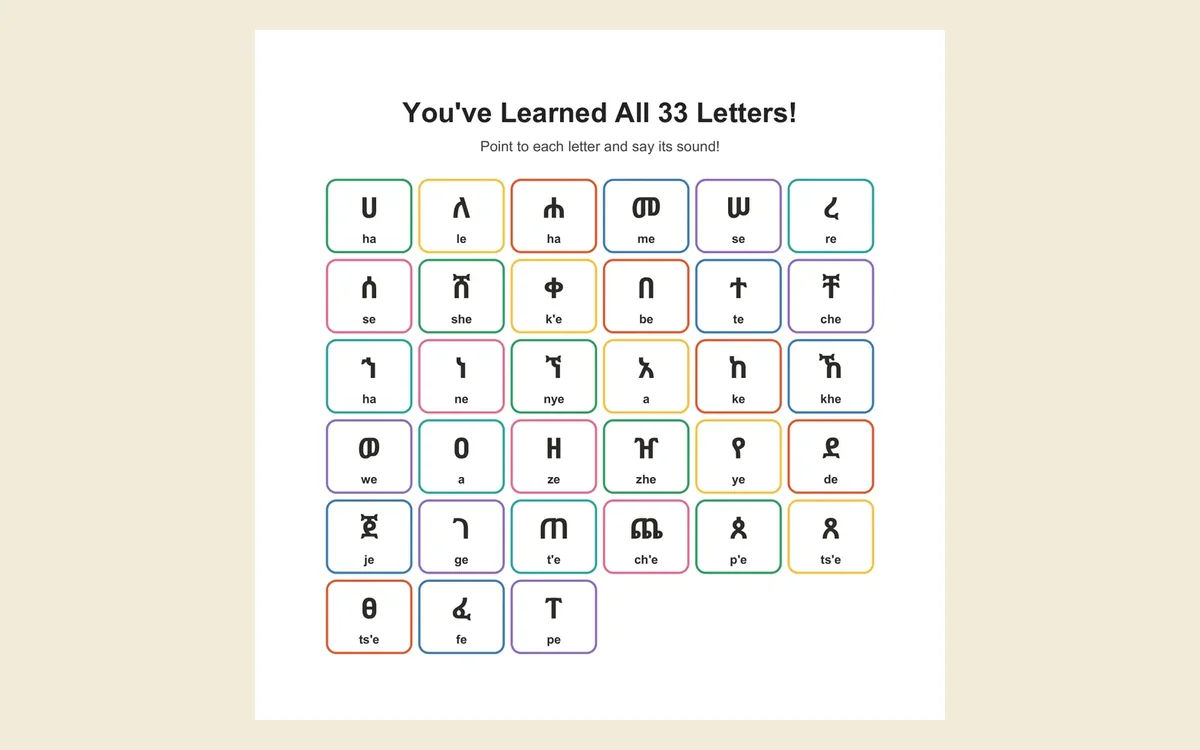
Fidel (ፊደል) is the alphabet used to write Amharic. The word itself means "letter" or "alphabet" in Amharic. Instead of separate letters for consonants and vowels, each Fidel character stands for a whole syllable, like ha, le or me. Children usually start with the 33 basic letters, and each of those has seven forms, one for each vowel sound.
If you didn't grow up reading Amharic, that can sound like a lot. The good news is that the system is very regular, and once you see the pattern it becomes much easier to teach.
Where Fidel comes from
Fidel is also called the Ethiopic or Ge'ez script. It began as the writing system for Ge'ez, an ancient language of Ethiopia and Eritrea that is still used in church today. Over time it was adapted for other languages, including Amharic and Tigrinya.
Unlike Arabic or Hebrew, Fidel is written from left to right, just like English.
How Fidel works: one letter, seven forms
Each basic letter is a consonant paired with a vowel. To change the vowel, you change the letter's shape slightly: a small stroke, a ring or a change to one of its legs. These seven versions of a letter are called a family (sometimes called "orders").
Here is the first family, the letter ሀ (ha):
| ሀ | ሁ | ሂ | ሃ | ሄ | ህ | ሆ |
|---|---|---|---|---|---|---|
| ha | hu | hi | ha | hé | h | ho |
Every family follows the same vowel order. Here's the letter ለ (le), with the vowels in the same positions:
| ለ | ሉ | ሊ | ላ | ሌ | ል | ሎ |
|---|---|---|---|---|---|---|
| le | lu | li | la | lé | l | lo |
Once your child knows the order of the vowel sounds, each new family is mostly about learning one new consonant.
How many letters are there?
Most Amharic alphabet books for children teach 33 basic letters. Some charts add a 34th, ቨ (ve), used mainly for words borrowed from other languages. With seven forms each, that's well over 200 characters, plus a few extra combined forms (such as ሏ, lwa) that are usually learned later.
That number is less scary than it looks. Children aren't memorising 200 separate shapes. They're learning 33 consonants and one repeating pattern.
Letters that sound the same
Some letters share a sound in modern Amharic, even though they were pronounced differently in ancient Ge'ez:
- ሀ, ሐ and ኀ are all pronounced ha
- ሰ and ሠ are both se
- አ and ዐ are both a
- ጸ and ፀ are both ts'e
When you're starting out, simply teach them as "the same sound, different letter". Which one to use in a word is something children pick up later through reading.
Sounds that don't exist in English
A few Amharic sounds are made with a little pop of air from the throat. In English-letter spellings these are often written with an apostrophe:
- ቀ (k'e), as in ቀይ, k'ey, "red"
- ጠ (t'e), as in ጦጣ, t'ot'a, "monkey"
- ጨ (ch'e), as in ጨረቃ, ch'erek'a, "moon"
- ጰ (p'e) and ጸ (ts'e)
English spellings can only get you close to these sounds. If you can, ask a fluent family member to say them aloud, and copy them together.
How to start teaching Fidel at home
You don't need to be fluent to begin. A few simple habits go a long way:
- One family at a time. Learn the first form of a letter together, then its seven forms. A family a week is a comfortable pace for young children.
- Connect each letter to a word. ሀ for ሀገር (hager, country), ለ for ላም (lam, cow). A picture and a word make a letter much easier to remember than its shape alone.
- Say it, point to it, trace it. Little ones learn by doing. Tracing a letter with a finger while saying its sound works better than looking at it.
- Read the families out loud like a song. Ha, hu, hi, ha, hé, h, ho. The rhythm helps children remember the vowel order.
- Keep it short and fun. Five or ten minutes a day is better than an hour once a week.
A first book to make it easier
We made our book, Fidel: My Amharic Alphabet Book, for exactly this. Each of the 33 letters has its own page with the big letter to trace, an everyday word with a bright picture, its English meaning, and all seven forms with easy English-letter spellings. A review page at the end brings the whole alphabet together.
It's designed for English-speaking families learning Amharic together, so you don't need to know any Amharic to use it with your child.